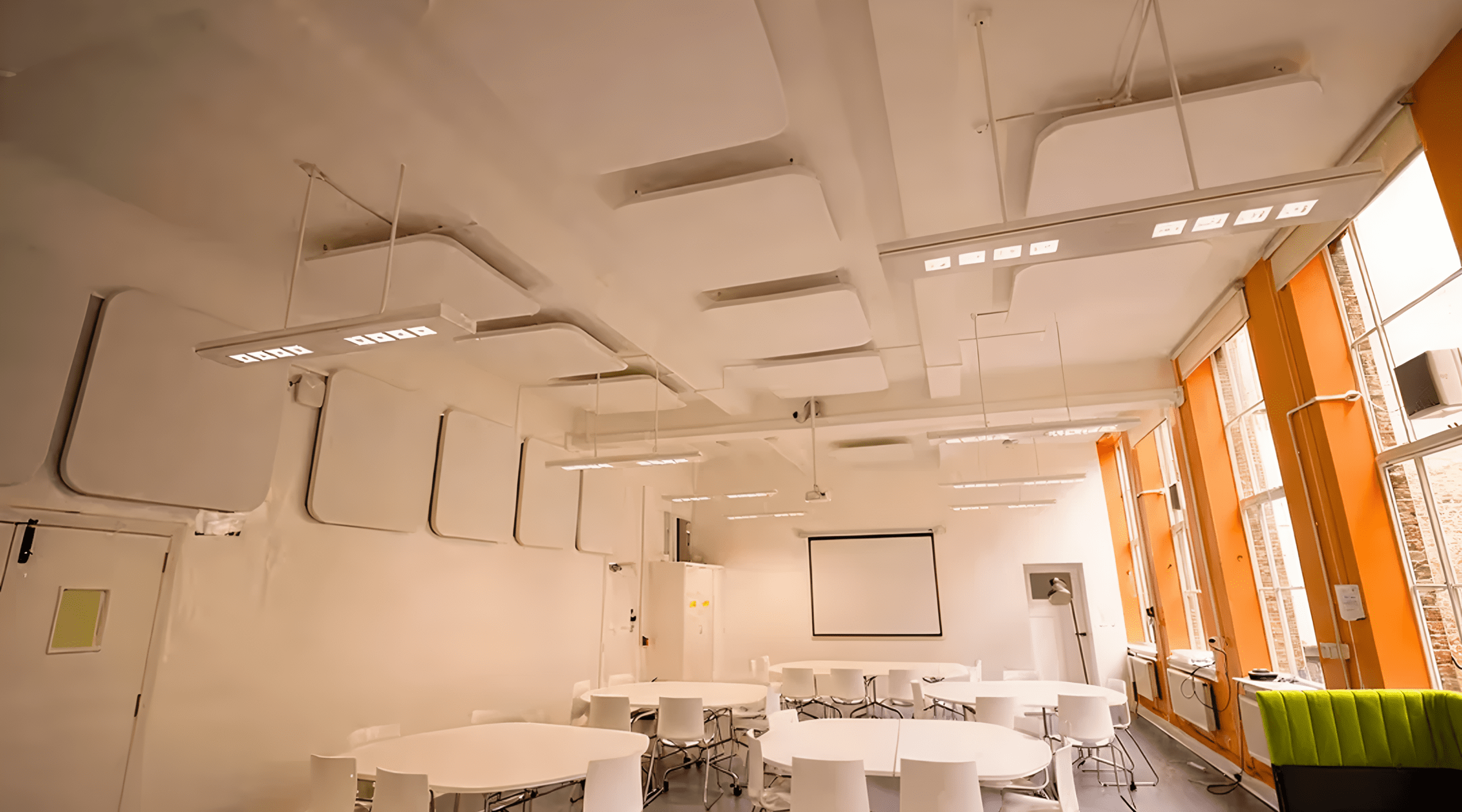
Educational buildings and universities rely heavily on clear sound and controlled acoustic environments to support learning, teaching, and academic performance. From classrooms and lecture halls to libraries and research facilities, acoustics directly influence speech intelligibility, student concentration, and overall educational outcomes. Poor acoustic conditions can undermine even the most advanced educational programs.
This article explores the importance of acoustic solutions for educational buildings and universities, common challenges in academic environments, and best practices for achieving effective and compliant acoustic performance—highlighting the professional approach adopted by ACOUSTIEG.
This article explores the role of acoustic solutions for government and public sector buildings, key challenges these facilities face, and best practices for delivering reliable, compliant, and long-term acoustic performance—drawing on the professional methodology applied by ACOUSTIEG.
Learning is primarily an auditory process. If students cannot clearly hear instructors, comprehension and engagement decline. Inadequate acoustics often result in:
Poor speech clarity in classrooms
Increased student distraction and fatigue
Higher vocal strain for teachers and lecturers
Unequal learning experiences across different spaces
Greater impact on students with hearing difficulties
Well-designed acoustics, on the other hand, support:
Classrooms and Large Lecture Halls
Large volumes and high ceilings often cause:
Corridors and Shared Spaces
Student movement and social interaction generate noise that can easily spill into nearby learning spaces.
Mixed-Use Academic Campuses
Universities often combine:
Social and recreational areas
Without proper planning, these functions can conflict acoustically.
Hard Architectural Finishes
Concrete, glass, and exposed surfaces increase sound reflection and echo if not acoustically treated.
Acoustic treatment focuses on improving sound quality within a room by controlling reflections and reverberation. It is essential for:
The goal is to achieve optimal reverberation time and clear speech intelligibility.
Soundproofing prevents noise transfer between spaces, protecting concentration and learning continuity. It is commonly applied between:
Effective sound isolation ensures that activities in one space do not disrupt another.
Speech clarity is the foundation of education. Acoustic design supports this by:
HVAC systems, laboratory equipment, and technical installations can introduce constant background noise. Acoustic control ensures these systems do not interfere with teaching and learning activities.
Professional educational acoustics are based on measurable criteria, including:
RT60 (Reverberation Time): for speech clarity
Meeting these standards ensures consistent acoustic quality across classrooms and campus facilities.
Function-Based Design: Classrooms, lecture halls, libraries, and laboratories each require different acoustic strategies.
Architectural Integration: Acoustic solutions should align with architectural design without visual disruption.
Testing and Verification: Post-installation measurements confirm performance targets are achieved.
ACOUSTIEG delivers acoustic solutions for educational buildings through a structured, engineering-driven methodology that includes:
ACOUSTIEG approaches acoustics as a core contributor to educational quality—not as a secondary technical detail.
Acoustic solutions are fundamental to the success of educational buildings and universities. Clear speech, controlled noise, and balanced sound environments directly affect learning effectiveness, teaching quality, and student well-being.
When acoustics are planned scientifically and implemented professionally, educational spaces become more inclusive, efficient, and conducive to learning. With the expertise of ACOUSTIEG, schools and universities achieve acoustic environments that support academic excellence and long-term campus performance.
Access your dashboard, manage your projects, and explore our full services
Don’t have an account? Sign up